
In San Marcos every permit, for an ADU, a remodel, an addition or a new house, is the City Building Division's, filed through an online portal, with Planning, Land Development Engineering and Fire Prevention reading the set in about 15 business days. The City repealed and replaced its ADU chapter on September 24, 2024 for the state's 2023 bills, and nothing in it reflects the 2025 session, so on two points state law overrides it: a junior ADU's owner must live on the lot only while the unit shares the house's bathroom, and a lease runs longer than 30 days. The City publishes ten permit-ready detached plans from 498 to 999 square feet with one flat fee, its public facilities fees start above 750 square feet, and its fire district's 2025 codes ask 150 feet of fuel modification around every structure in a hazard area.
BHI in San Marcos, from the record
- 1997Licensed in California sinceCheck the license
- 111Permits on the public record, 2000 to 2025See the projects
- 5.0Google rating from 17 reviewsRead the reviews
- A+Better Business Bureau ratingSee the BBB profile
Five of the 111 permits on BHI's public record are City of San Marcos permits, issued between 2016 and 2022: a room addition with a deck above it, a 234 square foot second-floor addition, two pool and spa permits, and two patio covers with an outdoor fireplace. A sixth, a 400 square foot detached carport finished in 2023, is a County permit with a San Marcos mailing address. BHI's ADUs of 2024 and 2025 were permitted in Escondido and on the County land beside it.
Who issues permits here, and how does plan check run?
The City of San Marcos's Building Division issues building permits inside the city limits, and every permit runs through the City's online permitting system, with a permit guide beside it. Plan review typically takes about 15 business days, corrections come in writing and the set goes back in, and construction and the first inspection have to start within twelve months of issuance. City Hall opens weekdays from 7:30 am to 5:30 pm and closes alternate Fridays.
Four desks sign an ADU: Planning, Building, Land Development Engineering and Fire Prevention, and all four approve before the inspector signs the final; the water and sewer agencies sign the permit before any final too. For an ADU the City's chapter sets the decision at 60 days from a complete application, with the state adding the 15 business days the City has to say whether the application is complete, and a permit-ready plan is decided in 30 days. An ADU filed with a new house waits for the house's decision, a garage you take down for it is permitted in the same review, and a rejection comes with a written list of what is missing.
Two steps are San Marcos's own. Before the foundation inspection on any new building the permit holder files a setback certification prepared by a California licensed surveyor, on the City's form updated October 13, 2026, and no foundation work starts until the City has reviewed it. And before the City issues an ADU's building permit it obtains a will-serve letter from every agency with jurisdiction over the unit's utilities, so the water and sewer district's sign-off comes early rather than at the end. On a septic lot the County's health department approves the system first.
Engineering issues a grading permit unless the work is exempt, and the exemption does not cover work in a floodway or floodplain or 5,000 square feet or more of new impervious surface; a grading application brings a preliminary geotechnical report. Fire Prevention reviews sprinkler and alarm plans electronically through a consultant it names, with the fees paid to the Fire Department. Inspections run from 7:30 am to 4 pm in two-hour windows, requested online by 3 pm for the next business day.
For the projects homeowners bring most often:
- An ADU or junior ADU: the City's building permit under its chapter and state law, decided in 60 days, or 30 from one of the City's permit-ready plans; the will-serve letter first, the surveyor's setback certification before the foundation, the four divisions and the water district before the final.
- A kitchen or bath remodel touching plumbing, wiring or walls: the portal's building permit, about 15 business days of review.
- An addition or a second story: the zone's height and coverage, the surveyor's certification before the foundation, school fees above 500 square feet, sprinklers throughout when an addition passes half the building, and on a ridgeline lot the overlay's setbacks and heights.
- A new house: full plans with the geotechnical report where grading needs a permit, the fire district's access, sprinkler and fuel modification rules, the ridgeline overlay where it applies, the 2025 wildland code's construction in a hazard area, and the public facilities fees by the square foot.
Where do San Marcos's ADU rules differ from state law?
The City Council introduced Ordinance 2024-1551 on September 10, 2024 and adopted it on September 24, 2024, after a 7 to 0 Planning Commission recommendation on August 5, repealing and replacing Chapter 20.410 of the Municipal Code for the state's 2023 and 2024 bills: the number of units now follows the Government Code rather than a number of the City's own, owner occupancy left the ADU rules, the state's heights came in, the 60-day clock and the written deficiency list were written down, and a set of objective design standards replaced the subjective ones. The Council declined the state's condominium option on purpose. The comprehensive zoning update of December 2025 left the chapter alone, and the chapter itself says the Government Code prevails where the two conflict.
Nothing in the chapter reflects the 2025 session, and the City's only handout, a five-page FAQ dated January 2020, predates both the chapter and the bills, so the table follows the chapter and the statute, and the list after it says where the FAQ and the chapter still read differently. The California Housing Defense Fund wrote to the City in July 2024 that its design, location, parking and ridgeline standards cannot be applied to the units state law makes every city approve; the City kept them as objective standards and the statute's own words settle it for those units.
| Rule | In the City of San Marcos |
|---|---|
| Units on a lot | The number the Government Code sets as the minimum, which the chapter adopts by reference: on a single-family lot a unit converted from existing or planned space with 150 square feet added for its entrance, a junior ADU, and one new detached unit no larger than 800 square feet, 16 feet tall and 4 feet off the side and rear lines, plus the ordinary attached or detached ADU; on a multifamily lot conversions of non-living space and up to eight detached units. The FAQ's one detached ADU and one junior ADU, and its two detached units on a multifamily lot, are the 2020 rule. |
| Size | The smallest of these: half the house's living area, never held under 850 square feet; 850 for a one-bedroom unit; 1,000 with more than one bedroom; and 1,000 for a detached unit on a lot of an acre or more. A junior ADU 500. The 1,000 cap is one a city may set; the statute's own floor is 1,000 for a unit with more than one bedroom, so a two-bedroom unit beside a small house is allowed 1,000 whatever the half-house rule gives. |
| Height | A detached ADU 16 feet; 18 feet near a major transit stop or a high-quality transit corridor, a half-mile walk, with 2 feet more when the roof pitch follows the house's, 20 at most; 18 feet on a multistory multifamily lot; an attached ADU 25 feet or the zone's limit, whichever is lower, never more than two stories. No story limit on a detached unit; the FAQ's one story and 16 feet is the old rule. |
| Where on the lot | A detached ADU sits in the rear half of the lot, 4 feet from the side and rear lines and 10 feet eave to eave from any other building, never in the front setback or closer to the street than the house; a conversion or a same-footprint rebuild keeps its setbacks. The one exception the chapter writes is the state's 800 square foot unit where no other feasible location exists. The statute bars any front setback rule that stops an 800 square foot unit and any unauthorized standard on the units it makes the City approve, and governs for them; a larger custom unit follows the City's rule. |
| Design | Architecturally compatible with the house: the same roofing material and roof design, fascia, finish, colour, doors and windows down to the window ratios, garage door and enhancements, or the house modernized to match. Objective, as the 2024 rewrite intended; the statute keeps it off the units it makes the City approve. |
| Parking | One paved space of 9 by 18 feet, with the state's exemptions: none for a lot within half a mile's walk of transit, in a historic district, for a unit made inside the house or an accessory building, where the street's permit parking is closed to the unit, within a block of a car share, or when the ADU comes with a new house. Parking lost to an ADU is not replaced. |
| Junior ADU | 500 square feet inside an existing or planned house, its attached garage included, with an interior entrance when the bathroom is shared, and a recorded deed restriction. The chapter requires the owner in the house or the unit in every case; since January 1, 2026 the statute requires it only while the unit shares the house's bathroom, and the statute governs. |
| Owner occupancy | None for an ADU, since the 2024 rewrite; the FAQ's holiday to January 1, 2025 is history. A junior ADU as the row above says. |
| Rentals | The chapter allows a term of 30 days or longer, though its own staff report said 31; the statute requires a term longer than 30 days, so a 31-day lease is the safe floor. Short-term rentals are not permitted in residential zones at all. |
| Selling a unit on its own | A junior ADU, never. An ADU through the nonprofit route alone; the Council chose not to adopt the condominium ordinance the state allows. |
| Sprinklers and solar | No sprinklers unless the house itself needs them. The permit-ready plans list a solar package and a possible sprinkler system as deferred submittals. |
| Utilities | A will-serve letter from every utility before the permit; no new connection or fee for a unit inside existing space; the County's health department on a septic system. The City itself charges no capacity fee; Vallecitos' and Vista Irrigation's are in the fees section. |
| Nonconforming conditions | Not corrected as a condition of the ADU unless they threaten health or safety; a unit built without a permit before 2018 is not denied for a code or standards violation without a health and safety finding. |
| Ridgeline lots | The Ridgeline Protection Overlay's setbacks, heights and grading limits apply to an ADU as to anything else; a specific plan may not change them. |
Where the 2020 FAQ or the chapter still reads differently from the statute, and what governs:
- Junior ADU occupancy and the rental term: the statute, as the table says.
- The fee line. The FAQ and the chapter exempt a unit smaller than 750 square feet; the statute exempts 750 square feet or less, so a unit of exactly 750 pays no public facilities fee.
- The 60-day clock. The FAQ says it stops when the City sends corrections; the statute stops it only at the applicant's request and deems the unit approved if the City does not act.
- The FAQ's one story, its owner-occupancy holiday, its two detached units on a multifamily lot and its front-yard ban are all the 2020 rules; the chapter and the statute govern.
- The rear-half, design, parking and ridgeline standards on the units state law makes the City approve: the City calls them objective and kept them; the statute's "notwithstanding" governs for those units, and a larger custom unit meets the City's rules.
Can you build from a pre-approved ADU plan here?
Yes. San Marcos's permit-ready program offers ten plan files, all dated March 3, 2025, for detached one-story units: a 498 square foot one-bedroom, two 748 and 749 square foot two-bedrooms, an 863 square foot L-shaped two-bedroom, and 992 and 999 square foot three-bedrooms, several in a reversed version. No alteration to a City set is considered; a changed design goes through the ordinary ADU permit. The City decides a permit-ready application within 30 days of a complete one, reviewed by Planning, Building, Land Development Engineering and Fire Prevention, issues it only to the owner or a California licensed contractor, and charges one flat plan check fee and one flat permit fee for any City standard unit up to 1,000 square feet, where a custom ADU pays by valuation. The truss and solar packages, and a sprinkler system where one applies, are deferred submittals.
One thing to confirm with Building: the plans were drawn under the 2022 codes and the 2025 codes took effect on January 1, 2026, and the state's 30-day clock runs only on a plan pre-approved in the current code cycle; no City page says whether the set has been re-approved under the 2025 codes.
Fire, ridgelines, specific plans and floodplains
The City adopted the State Fire Marshal's map of March 24, 2025 without change, introduced May 13 and read a second time on May 27, 2025, its first local map update since 2009, and San Marcos is among the cities that gained at least a tenth more very high land between 2011 and 2025. The 2025 Fire Code and the 2025 Wildland-Urban Interface Code followed on December 9, 2025, with the City's own findings on its brush-covered hillsides, Santa Ana winds and narrow winding roads: fire access roads of 24 feet, or 16 for up to two houses; residential sprinklers in every new house and throughout a building when an addition passes half of it; a fuel modification zone of 150 feet around every structure in or beside a hazardous fire area, reducible for ignition-resistant construction but never below 100 feet; a single-story building 15 feet back from the top of a slope and a two-story one 30; Zone 0 with no mulch; and a fire protection plan the fire official may require on a ministerial permit as well as a discretionary one. Defensible space runs 100 feet from a house built before 2004 and 150 feet from a newer one.
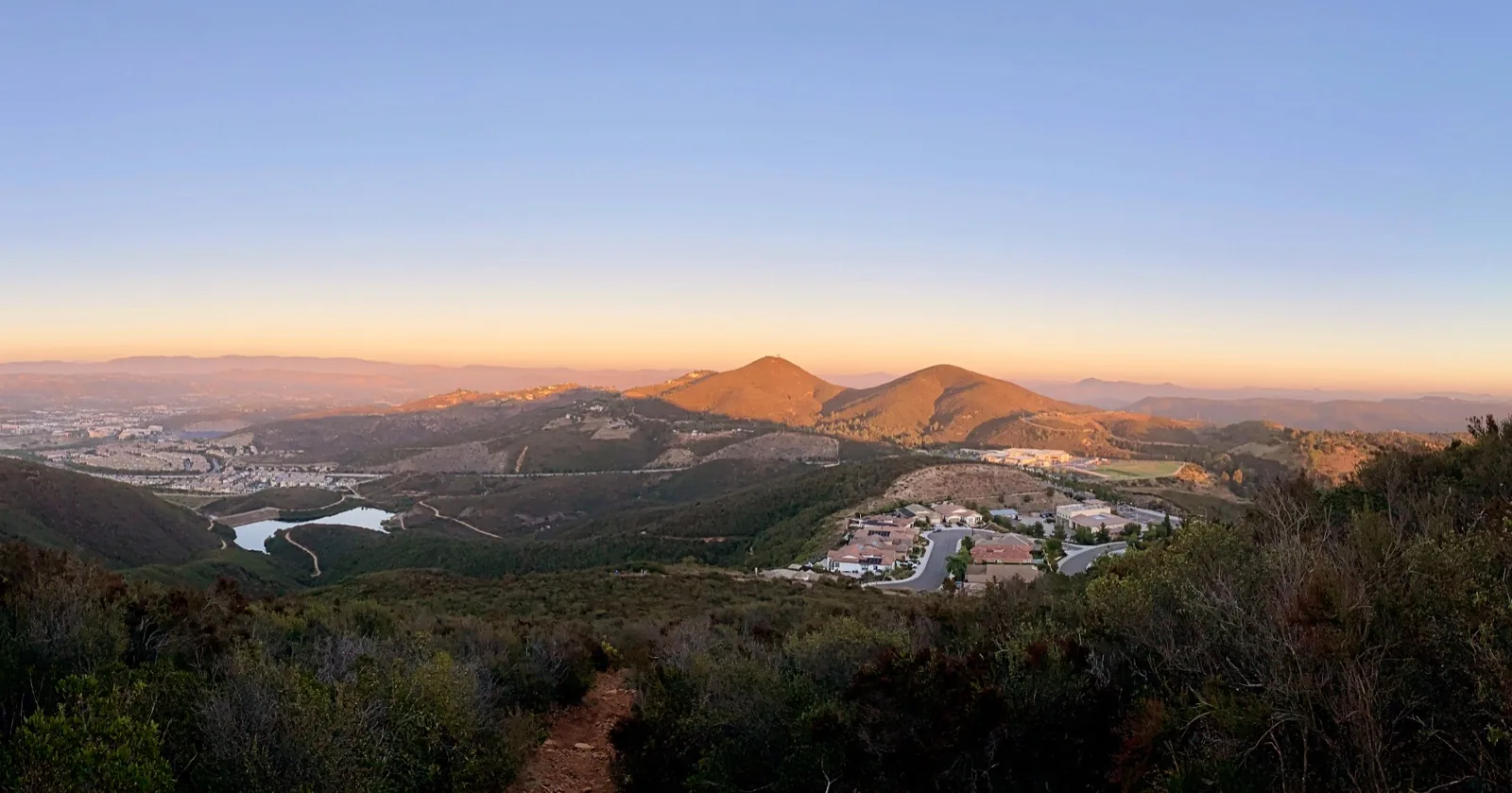
The Ridgeline Protection and Management Overlay is a voter measure of 2006, restored to its ballot text in December 2025: primary and secondary ridgelines mapped on P Mountain, Owens Peak, Franks Peak, Double Peak, Cerro de las Posas in San Elijo Hills and the southern hills, with no structure inside the 100-foot vertical setback of a primary ridgeline or the 50-foot setback of a secondary one unless the Planning Commission approves a modification on a simulation, then 24 feet at most and 28 elsewhere, no flat roofs, grading on a quarter of the lot at most, and exemptions for existing houses, modest expansions and a new accessory building of 200 square feet or less. The ADU chapter applies the overlay's standards to ADUs.
Much of the city lies in specific plan areas, San Elijo Hills the largest, whose own standards govern where they speak and whose silences the zoning ordinance fills; the San Elijo Hills plan lists a casita among accessory uses and says nothing of ADUs, so the City's chapter and state law apply there, as the FAQ already said for every specific plan lot. Along San Marcos Creek and the City's other channels the Flood Damage Prevention Overlay applies the federal flood maps, with the City Engineer as floodplain administrator reviewing every permit. The City has no historic preservation chapter, so no age-based review attaches to an ADU, and the research found no reach code or electrification ordinance.
Which fees apply, and where are the schedules?
The City's development fee schedule took effect on March 3, 2025, adopted in November 2024 on a fresh nexus study, and was indexed on September 1, 2026: a custom ADU's plan check and permit fees run by valuation, the permit-ready units pay one flat fee each, and the public facilities fees, for transportation, parks, fire protection, advanced planning, habitat and storm drains, are charged per square foot of new residential floor area, with a two-year grace period for applications active before March 2025 and a deferral program to utility release secured by a lien. Annexation into the City's community facilities districts carries a fee per district or an in-lieu payment.
- Public facilities fees. None on an ADU of 750 square feet or less of interior living space, and a share in proportion to the house above that, under the chapter read with the statute; the City charges no capacity fee of its own. Which per-square-foot class a larger detached unit takes is not written down, so ask at intake.
- School fees. San Marcos Unified, the city's one district, charges by the square foot on new residential space of 500 square feet or more, ADUs named, and on a garage conversion that turns non-assessable space into living space; a unit under 500 square feet pays none.
- Water and sewer. Vallecitos Water District serves most of the city for water and sewer, with Vista Irrigation District and the Buena Sanitation District in parts; their fees are paid to them directly. Vallecitos' 2026 capital facility fees price a 3/4-inch meter and a single-family sewer unit, its policy allows one meter and one lateral per parcel with a separate meter for each premise, and neither it nor Vista Irrigation publishes an ADU rule; state law bars a connection fee or capacity charge on a unit inside existing space and caps a new unit's at its share.
- Everything else. The fire district's plan check and sprinkler review fees paid to the Fire Department, the surveyor's setback certification, a geotechnical report where grading needs a permit, and the inclusionary in-lieu fee the schedule sets per square foot of residential construction, which the City's chapter does not apply to an ADU in words and which belongs to the questions for intake.
How many ADUs San Marcos permits
San Marcos reports its ADU building permits to the state every year: 2 in 2018, 44 at the peak in 2024, 30 in 2025.
- 22018
- 22019
- 62020
- 182021
- 322022
- 292023
- 442024
- 302025
Building permits issued as San Marcos reported them to HCD by reporting year (Table A2, ADU category), not units finished, with no junior ADU category on the state's form; the 2022 report holds 8 units permitted in 2021. The City's own summaries give the same 29 for 2023 and 44 for 2024, with 16 and 34 completed, and 14 permitted and 32 completed for 2025, where the state's dataset carries 30.
Recent changes in San Marcos
What has changed in the City's permit rules since 2024, newest first.
Since San Marcos's 2024 chapter takes the Government Code's minimum unit count by reference, the second new detached unit of up to 800 square feet should apply here from January 1, 2027 with no local amendment; ask Planning to confirm. Our walkthrough of AB 956 has the specifics.
The surveyor's setback certification form was updated.
The indexed 2026 fees took effect, adopted June 23, 2026: the public facilities fees up 2.7 percent on the construction cost index and the user fees 3.2 percent.
San Marcos Unified's board approved the higher school fee rate the State Allocation Board set in January 2026.
The City approved its 2025 annual progress report: 14 ADUs permitted and 32 completed, by its own count.
The 2025 California Building Code was adopted into the Municipal Code, in force since January 1, 2026, the day the state's 2025 ADU bills took effect and the water districts' 2026 fees began.
The 2025 Fire Code and the Wildland-Urban Interface Code were adopted, with the 150-foot fuel modification zone, the slope setbacks and Zone 0, and the Title 20 update restored the ridgeline overlay to its 2006 text; all three introduced November 10.
Ordinance 2025-1559 adopted the State Fire Marshal's 2025 fire hazard severity zone map without change, introduced May 13.
The 2025 development fee schedule took effect, with the permit-ready units' flat fees and the public facilities fees by the square foot; the ten permit-ready plan files carry the same date.
The Council adopted the development impact fee nexus study and the 2025 fee resolutions, and on December 2 rewrote the fee chapter of the Municipal Code.
Ordinance 2024-1551 repealed and replaced the ADU chapter for the 2023 and 2024 state bills, introduced September 10 after the Planning Commission's 7 to 0 recommendation of August 5.
What BHI has seen here
Past the chapter: what BHI's own permit record shows in San Marcos.
BHI's public permit record holds five City of San Marcos permits, issued between September 2016 and November 2022: a room addition with a deck above it in 2016, a pool and spa in 2020, a 234 square foot second-floor room addition, two patio covers with an outdoor fireplace and a second pool and spa in 2022, all issued by the City; the City's record shows issue dates only, so its review times are not on the public record. A sixth permit with a San Marcos mailing address, a 400 square foot detached carport, is the County's, opened and issued on the same day in March 2023 and completed. None is an ADU, so the City's 15-business-day review figure and the chapter's 60-day clock are the planning figures, and BHI's measured ADU plan-review times are the County's on its Escondido-area units.
What an ADU might rent for in San Marcos
Nobody publishes a rent for ADUs alone; what the table holds is HUD's FY2027 Small Area Fair Market Rent for each of San Marcos's two ZIP codes, the ROI calculator's starting figures: the rent below which four in ten recent movers pay, by size, with utilities.
| ZIP | Studio | 1 bed | 2 bed | 3 bed |
|---|---|---|---|---|
| 92069 | $2,190 | $2,330 | $2,820 | $3,740 |
| 92078 | $2,480 | $2,640 | $3,190 | $4,230 |
HUD's FY2027 rents for ZIP 92069 and ZIP 92078 by bedroom count, the ROI calculator's own inputs; where a ZIP crosses the city line it sits under San Marcos because most of its people live there. The ROI calculator projects them over 30 years for your lot.
Next steps
Check your lot against San Marcos's chapter, its ridgeline map and its fire zones, price the ADU, then read what fits your project.